Two Halves of One Problem
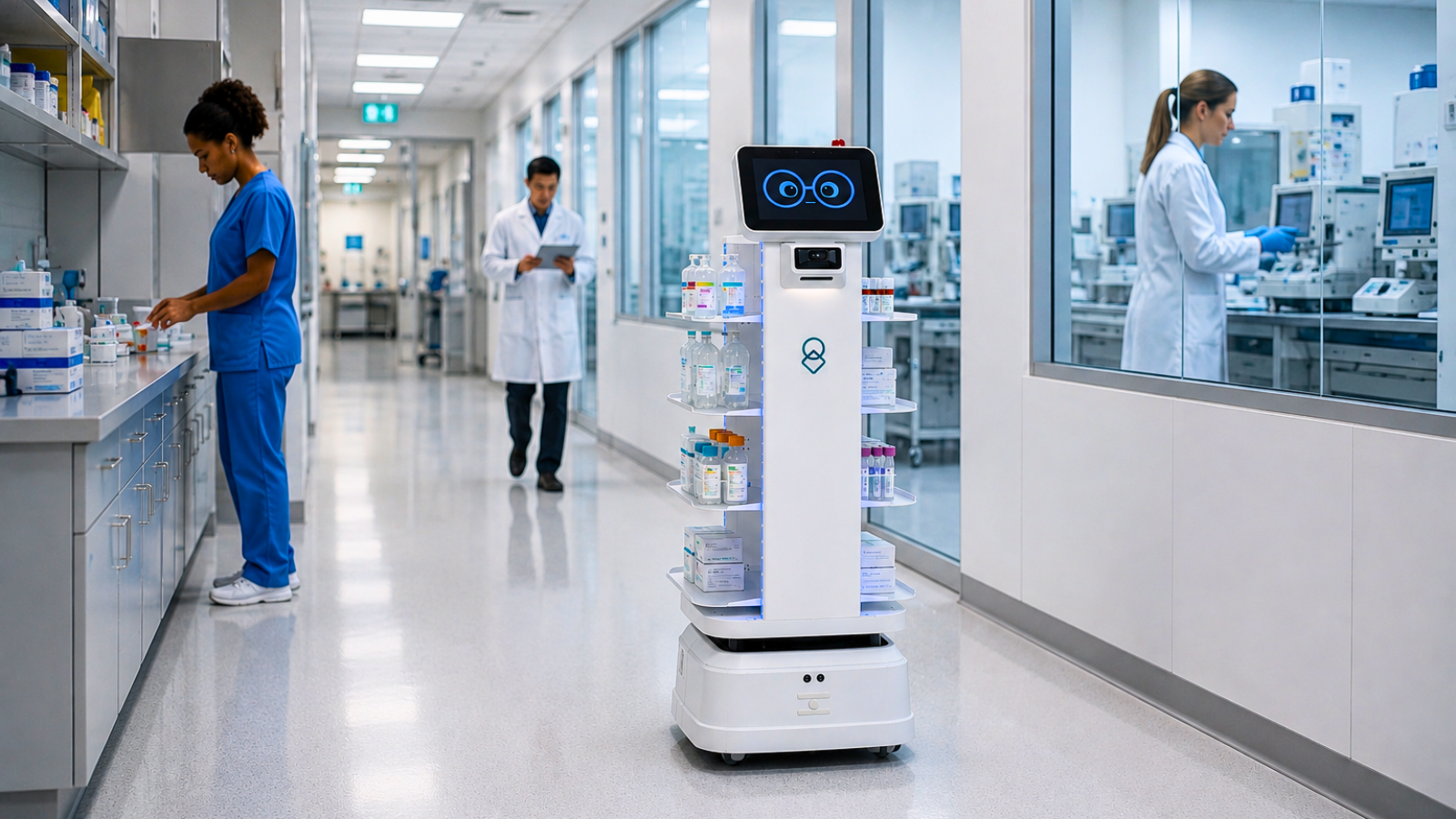
Hospital logistics automation is usually sold in two separate conversations. One is about robots in corridors carrying supplies, meals, specimens and linen. The other is about inventory — barcodes, RFID, smart cabinets, weighted bins, and the periodic ritual of a person walking the shelves with a clipboard. Different vendors, different budget lines, often different executives.
They are the same project. Gartner made a version of this argument in research published in August 2026, advising healthcare chief supply chain officers to plan for self-managing supply rooms in which ceiling-mounted cameras sense stock continuously, machine learning reads usage patterns and clinical schedules to trigger replenishment, and point-of-care guidance walks a nurse to the right shelf. The framing its analyst used is the right one: the opportunity is to remove the counting work rather than make it incrementally faster.
The corollary is what the research does not say out loud. A supply room that knows what it holds still needs someone or something to move material into and out of it. A robot that moves material still needs to be told what to move and where it should go. Automate one and the constraint relocates to the other. We have watched hospitals buy a delivery fleet, run it well, and discover that the limiting factor is now a par-level spreadsheet that was last accurate in March.
Why the Count Comes First
If you can only do one first, do the count. Three reasons.
The first is arithmetic. Sensing and inventory infrastructure is generally the cheaper half, and much of it is already installed in most hospitals in some partial form — barcode systems, some RFID, cabinets in the high-value areas. Extending what exists costs less than a robot fleet and does not require any change to how corridors are used.
The second is that a delivery robot amplifies whatever the inventory data tells it. If par levels are wrong, an automated replenishment schedule delivers the wrong quantity to the wrong unit reliably and on time, which is worse than a nurse walking to the stockroom. Automation does not forgive bad master data; it industrializes it.
The third is political. Inventory accuracy produces a visible win in weeks — fewer stockouts, fewer expired products on back shelves, less time hunting. That win buys the credibility you will need when you ask the same committee to let robots into the corridors. Doing it the other way round means asking for the harder change first, on the strength of a promise.
What Actually Gets Given Back
The honest version of the value case is about where clinical time goes, and the research on that is unusually consistent. Time-motion work across settings finds nurses spending a substantial share of every shift on non-clinical activity — hunting for supplies, transporting specimens and medications, restocking rooms, waiting on material. The exact percentage varies by study and by unit, and anyone quoting a single figure across all of nursing is overreaching. What does not vary is the direction: a meaningful fraction of the most expensive and scarcest hours in the building is spent moving things.
The staffing evidence gives that a sharper edge. Research from the University of Pennsylvania School of Nursing, published in 2026 across roughly 550,000 medical-surgical patients in 132 Pennsylvania hospitals, found that each additional patient added to a nurse’s assignment was associated with 8% higher odds of 30-day mortality, 4% higher odds of readmission, and longer stays — and separately with a 33% higher burnout risk, 43% higher job dissatisfaction and 27% higher intent to leave. The same group projected that moving to a four-to-one ratio would save tens of millions annually in turnover cost and considerably more in shortened stays.
Read those together and the logistics case stops being about cost per delivery. It is about whether the hours you already pay for are spent at the bedside. That is also why the Bureau of Labor Statistics projections matter to a supply chain officer: healthcare and social assistance is projected to add 2.2 million jobs through 2035, some 37% of all new US jobs, while office and administrative support declines by about 4%. The clinical roles are growing and hard to fill; the administrative layer around them is shrinking. Material still has to move.
The Virtual Nursing Warning
Here is the finding that should temper any business case, and we would rather put it in front of you than leave it out. In the same Penn Nursing body of work, a study of virtual nursing found that 57% of nurses reported no reduction in workload at all, and roughly 10% reported that their workload had actually increased. Virtual nursing is a well-regarded intervention with real successes elsewhere — other systems have documented reduced readmissions and thousands of bedside hours recovered. The point is not that it fails. The point is that a technology can be implemented correctly, produce genuine benefits somewhere in the system, and still not reduce the workload of the person it was supposed to help.
The mechanism is almost always the same. The technology removes one task and adds a coordination task. Someone now has to log in, hand off, verify, or answer a screen. If the new coordination burden lands on the same person who was doing the original task, net workload is unchanged.
Applied to logistics, the question to ask a vendor is precise: after deployment, who dispatches the robot, who loads it, who unloads it, and who deals with it when it stops? If the answer to all four is “the nurse,” the project will move work rather than remove it. Deployments that give time back are the ones where loading and dispatch belong to supply chain or environmental services staff, and the clinical unit is only a destination.
A Sequencing Plan That Works
A staged approach we have seen hold up in practice:
- Fix the master data. Par levels, item masters, unit-level consumption. Unglamorous, and the whole thing rests on it.
- Instrument the highest-volume supply rooms. Not all of them. Pick the two or three units that generate the most stockout complaints and put sensing there, so you learn what your consumption actually looks like against what the system believed.
- Run the replenishment predictively but keep a human in the approval loop for a full cycle. You are checking whether the model is right before you let it order.
- Introduce transport on one route. Central supply to two units, or laboratory to two collection points. One route, one shift, measured properly.
- Move the loading and dispatch responsibility off the clinical unit before you expand. If you cannot do this, stop and fix it — expanding will multiply the coordination burden.
- Expand by route, not by robot. Add the next route only once the previous one runs unattended for a month.
Most failed deployments we have looked at skipped step one or step five.
What to Measure, and What Not To
Measure the things that survive scrutiny from a CFO and from a nurse manager at the same time:
- Stockout events per unit per month — before and after, from the same source.
- Expired product write-offs — a clean financial number that inventory accuracy moves directly.
- Completed scheduled runs as a percentage of scheduled runs — the honest measure of whether the robot is working, far better than a vendor uptime figure computed on the platform rather than the task.
- Trips off the unit per nurse per shift — observed, not surveyed, on a sample of shifts before and after.
- Time from specimen collection to laboratory receipt, where transport is in scope.
What not to lean on: a single headline percentage for “nursing time returned.” The figure varies enormously by unit and building, the derivation is usually opaque, and a nurse manager will not believe it. An observed reduction in trips off the unit on your own floors is a smaller claim and a far more persuasive one.
Where This Goes Wrong
Buying the corridor before the count. Covered above, and the most common and most expensive error.
Treating elevators as a detail. In a multi-floor building, elevator integration is the project. It involves the elevator vendor, your facilities team, and often a controller upgrade with a lead time measured in months. Establish this in the feasibility stage, not after the purchase order.
Leaving the network until commissioning. Coverage at robot height — roughly knee to waist, in corridors, near metal carts and lift lobbies — is not the same as coverage at laptop height. Roaming behaviour between access points matters more than raw signal strength. Survey before you buy.
Underestimating the first thirty days. Staff form a view of a robot in the first fortnight and it is difficult to shift afterwards. Overstaff the launch, respond to problems within the hour, and make sure the person on the unit knows who to call.
Letting the pilot become permanent. A one-route pilot that runs for two years without expanding is a project that quietly failed. Set the criteria for expansion before you start, and hold the review meeting on the date you set.
Mapping a Hospital Deployment?
We survey the network, walk the routes, and tell you honestly which runs suit automation and which do not. That conversation costs you nothing and usually shortens the project.
Get in Touch